
Many men are drawn to shy girls, and the reasons are more layered than most people assume. It is not simply about quietness or a soft voice. The appeal tends to come from a mix of psychology, culture, and the way shyness gets portrayed in media. This piece looks at those reasons in plain terms, without leaning on stereotypes, and treats shyness as one personality trait among many rather than a fixed type. You can also browse all creators if you want to see how varied these personalities can be.
What shyness actually means in practice
Shyness is usually a response to unfamiliar social situations. Someone who is shy may warm up slowly, think before speaking, and take a while to feel comfortable around new people. It is not the same as being cold or uninterested. Often it is the opposite: a shy person may care a lot about how they come across, which is why they hold back at first.
Understanding this distinction matters. A lot of what men describe as attractive about shy girls is really about that slow warming up, not about silence itself. When someone opens up over time, it tends to feel earned. That sense of gradual familiarity is a big part of what draws people in.
The reassurance factor
Some men say shyness feels low-pressure. A person who is not performing confidence or filling every silence can make a conversation feel calmer. For men who find loud, high-energy social settings draining, that calm can be a relief. In general, people are attracted to interactions that feel easy, and shyness sometimes reads as easy rather than demanding.

The attention that comes with it
When a shy person does share something, it can carry more weight. A small comment, a laugh, or a moment of direct eye contact tends to register more strongly because it is less constant. Many men describe noticing these small signals and reading meaning into them. Whether that reading is accurate or not, the feeling of being chosen by someone who is selective is appealing to a lot of people.
What men actually say they notice
Ask men what stands out about a shy girl and the answers are usually specific and fairly consistent. They mention eye contact that comes and goes. A smile that appears before someone looks away. Hands fidgeting with a sleeve or a cup. The way a person listens closely without needing to be the loudest voice in the room.
These are ordinary observations, and they say more about attention than about shyness itself. A man who notices these things is paying close attention to a person, and that attention often builds a sense of connection. It is less about a trait and more about the dynamic between two people.
- Slow, careful eye contact that feels deliberate.
- A quiet laugh rather than a loud one.
- Listening more than talking in group settings.
- Small, nervous habits that come across as genuine.
These details can also show up in visual media. If you look at sets like these White Stockings photos, the quiet, understated styling tends to read as reserved rather than showy. The same is true of Teen 18+ Indoor photos, where softer, more private framing often gives the impression of someone who is comfortable but not performing for a crowd.
The culture side of it
Culture shapes what people find appealing, and shyness has a long history in that story. In many places, being reserved was treated as a sign of good manners, especially for women. That expectation is not fair or universal, and it has caused real pressure on people who are naturally outgoing. But it does explain why shyness can carry a kind of social weight that other traits do not.
There is also a practical side. People often associate shyness with thoughtfulness, and thoughtfulness with care. Whether or not that holds true for every individual, the association is common enough that it shapes first impressions. It is worth being careful here, since a trait is never a guarantee of character.
Media and the quiet character
Film and television have spent decades building a picture of the shy character. She is often written as observant, loyal, and a little mysterious. She notices things others miss and says less than she thinks. These portrayals are popular partly because they leave room for the audience to imagine the inner life. A character who explains everything leaves less to wonder about.
This is why quiet styling tends to appear in a lot of visual work. Something like these Black Outdoor photos uses a plain, natural setting that can feel more like a real moment than a staged one. And a reserved look such as this White Sheer photos set tends to read as soft and private rather than attention-seeking, which fits the same idea.

Confidence and shyness are not opposites
A common mistake is assuming shy means insecure. They overlap sometimes, but they are not the same. Plenty of shy people are quite sure of themselves; they simply express it more quietly or need more time before they show it. Treating shyness as a lack of confidence can be unfair and usually inaccurate.
Men who prefer this trait often say they like the contrast between a reserved first impression and a warmer, more open person underneath. That contrast feels human. It also tends to make people feel special when they get to see past the surface. Some men describe that as the most appealing part, more than the shyness itself.
When the attraction can go wrong
Not every version of this attraction is healthy. Someone who wants a partner to stay quiet, dependent, or easy to control is not appreciating shyness, they are using it. A person who is reserved still has opinions, boundaries, and a full personality. A partner who respects that will give them room to warm up on their own terms.
There is a difference between liking someone's calm manner and wanting to keep them small. The first is a genuine preference. The second is a warning sign. Most men who say they like shy girls are describing the first, and the ones who are not tend to reveal it quickly.
Why the appeal keeps showing up
Shyness sits at a useful intersection for many men. It offers a calmer social pace, a sense of gradual intimacy, and a lot of small signals to pay attention to. Culture and media have reinforced these ideas for a long time, so the attraction is partly personal and partly learned. Neither explanation cancels the other out.
It also helps that shyness is common. Most people are a little reserved in new situations, which makes the trait easy to relate to rather than exotic. Men may see a bit of their own awkwardness reflected in a shy girl, and that recognition can feel like a shortcut to understanding. Related ideas come up in our glossary entries on the Parasocial Relationship and the Long Distance AI Girlfriend, since both touch on the appeal of a personality you discover slowly.
For others, a reserved look pairs with specific styling interests. Some people connect it to the Maid Fetish or the Garter Fetish, where the quiet character and a particular aesthetic overlap. Others just like the softer, private feeling that comes with a look such as these Brunette Cleavage photos or this MILF Standing photos set. The point is that shyness is never the whole story on its own.
If this sounds like your type, the picks below are a good place to start.
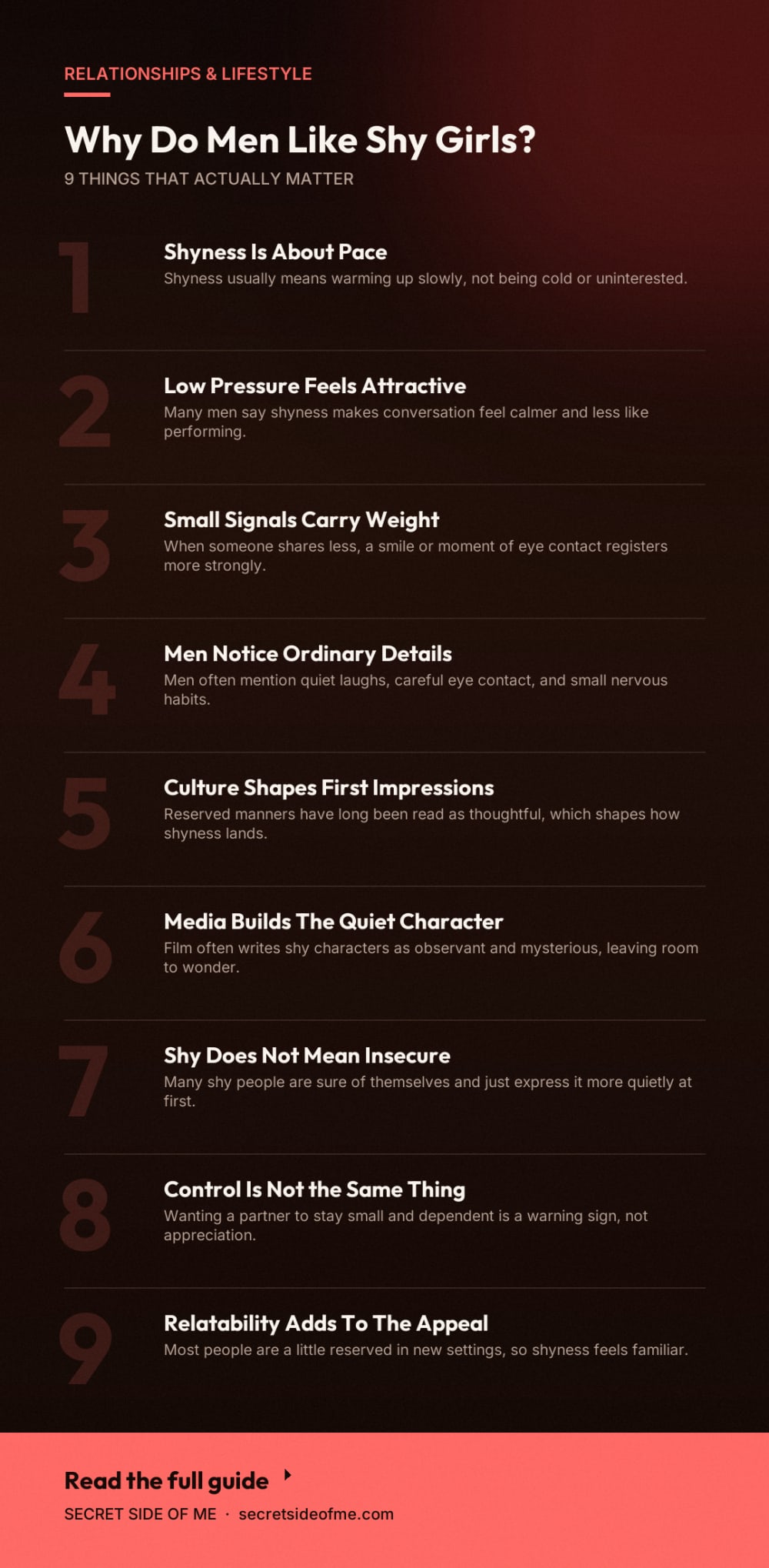
The short answer is that shyness gives a lot of men something to notice and something to earn. It reads as calm, it makes small signals matter more, and it fits with the quieter characters so many people grew up seeing on screen. Those are reasonable things to find appealing.
It also helps to remember that shy girls are people first, with their own reasons for being reserved. The trait is a starting point, not a full description of anyone.
Girls who fit this type
If this sounds like your type, these are the girls we would point you to first:
- Julie Rose. Shy at first. Worth the wait. See her photos or read her spotlight.
- Simone Davis. Quiet confidence, quietly dangerous. See her photos or read her spotlight.
Not sure what your type is? Take the quick quiz and find out.