Pet play is a form of roleplay where one adult takes on the persona of an animal, most often a puppy or a kitten, and the other takes a related role such as handler, owner or caretaker. It can be playful, it can be comforting, and it can be sexual, but none of those is required. People come to it for very different reasons, and the version one person enjoys can look nothing like the version someone else does.
The short answer to "what actually happens in it" is that it varies a lot. Some people keep it casual and silly. Others build longer scenes with clear rules and rituals. What holds it together is the animal persona, not any single activity or piece of gear.
What pet play actually involves
At its core, pet play is about a role. One person acts as the animal, and the other guides the scene, sets the tone and pays attention to how the first person is doing. The animal role can be loud and energetic or quiet and curled up at someone's feet. The handler role is mostly about attention and direction, not force.
Some people treat it as a way to switch off their usual responsibilities for a while. Being the pet means not having to decide anything. Being the handler means being the one who does. Either side can feel like a release, depending on the person.
It also does not have to be sexual. Plenty of people use it purely for comfort or relaxation, and for them the gear is closer to a costume. Others fold it into a sexual dynamic. Both are common and neither is the "real" version. It is not a fixed script either: two couples doing pet play can look completely different from each other.

Puppy play
Puppy play is the most visible form, partly because pup communities run meetups and online groups in many cities. The persona tends to be eager and high energy. Pups might bark, fetch, chew on toys or wrestle around, and there is often a training angle where the handler teaches simple commands and rewards good behavior. You can read the short version on the Puppy Play glossary page.
Collars, leashes and hoods come up, but plenty of people skip all of it. The dynamic matters more than the props. Some describe the appeal as a kind of mental quiet, getting to stop overthinking for a while and just respond.
Many pup communities are social rather than private. Group meetups and casual play events are a real part of the scene, which makes puppy play a bit different from forms that stay behind closed doors.
Kitten play
Kitten play usually runs quieter. The persona leans toward stretching, napping, kneading and seeking attention on the kitten's own terms. Where puppy play can feel like a workout, kitten play often feels slow and curious, with less training and more lounging. The Kitten Play entry covers the basics.
It overlaps in places with DDLG, another caretaker dynamic, though they are different things. The overlap is in the caretaking structure, not the animal persona, and some people move between the two or borrow from both. Nobody has to pick a side and stay there. The labels describe a style, not a box.
Other animal roles and in-between forms
Puppy and kitten get most of the attention, but they are not the whole picture. Pony play is a long-established form with its own gear, often built around dressage and carriage imagery. Foxes, bunnies and cows come up too, and some people use mythical creatures instead of real animals.
The persona often reflects what the person wants from the role. A pony scene tends to emphasize control and posture. A bunny scene tends to emphasize softness. Those are tendencies, not rules, and people mix and match freely.
There is also a middle ground. Some people borrow a few elements without adopting a full persona, like a collar here and a nickname there. That is common, and it does not need a name to be valid. For the ownership side of the dynamic specifically, see Owner and Pet Dynamic.

Common gear and terms
Gear is optional but popular. Collars, ears, tails, mitts and bowls are the usual items, and quality runs from cheap costume pieces to custom leatherwork. A person can do pet play in ordinary clothes and still be doing pet play.
A few terms come up often enough to be worth knowing:
- Handler or owner: the person guiding the scene.
- Pup or kitten: the person in the animal role.
- Headspace: the mental state that comes with the role.
- Pet regression: using the role for comfort rather than arousal.
Some people also pair it with other interests such as a choker or latex gear. Those are separate interests that sometimes overlap with pet play, not parts of it. The full definition lives on the Pet Play glossary page.
Safety, negotiation and aftercare
Any roleplay with a power exchange works best when both people talk first. That means agreeing on limits, on what the animal persona is allowed to do, on how long the scene runs, and on a way to stop. A Safeword matters more than any prop, and it works best when you set it before the scene rather than in the middle of it.
There are practical risks too. Crawling is hard on knees and wrists, and hoods can limit sight and hearing. Someone needs to keep an eye on the person in the animal role, especially in longer scenes. That is a real responsibility of the handler, not just a position of control.
Aftercare matters. Stepping out of a role can take a few minutes or much longer, and people differ. Some want quiet, some want to talk it through, some want a snack and a blanket. None of those is wrong. If any money or gifts are part of the dynamic, the same rule applies: say what you expect out loud and make sure everyone agrees.
It also helps to be honest about what you actually want. Some people enjoy the gear, some enjoy the headspace, some enjoy the attention. Knowing which one is driving you makes it far easier to explain to a partner.
Why people are drawn to it
The reasons vary. Some like the escape from everyday decision-making. Some like being cared for, or the structure of commands and rewards. Some just find the aesthetic fun. Pet play is also often misread from the outside: people assume it is always sexual or always about degradation, and neither holds up. A lot of it is closer to play than anything else.
Exploring the visual side
If you are still working out where your own interests sit, browsing is a low-pressure way to notice what holds your attention. You can browse all creators to see how differently people present themselves, or go through image categories. Mood and setting carry a lot of the impact, which is easy to see in Brunette Natural Light photos or Black Outdoor photos. For pose and posture, Blonde From Behind photos are worth a look, and styled looks show up in White Stockings photos and White Thighs photos.
For individual sets, Koharu Lin in a garter belt and fishnet stockings and Rashida Belle smiling with her long curly hair are staged looks. Amelia Bernardi kneeling with direct eye contact and Victoria Lane in the living room stay closer to a domestic setting, as do two Simone Davis sets, indoors, sitting and in the bedroom.
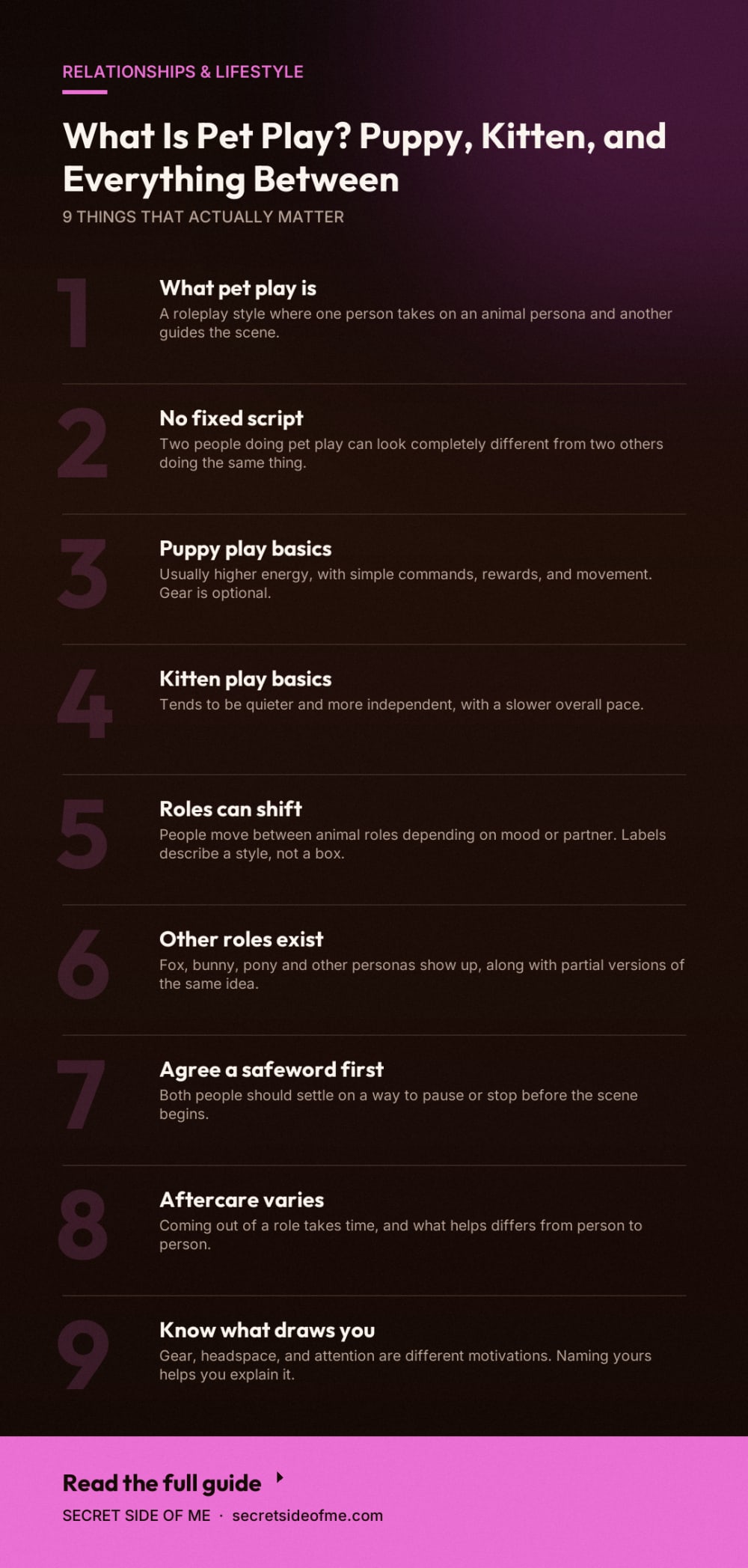
Pet play covers more ground than most people expect on first hearing the term. Puppy and kitten are the best-known forms, but pony play and other personas have long histories, and the reasons people come to any of them vary as much as the gear does.
What stays the same across all of it is what holds up any consensual roleplay: limits agreed in advance, a clear way to stop, and two people who both want to be there. The rest is preference, and preference is allowed to change.